Shakespeare
Mariners' Museum, Uncurated Search Results
Type: Pungy
Year:
Builder:
Location:
These records are found in the online catalog of The Mariners’ Museum and Park in Newport News, Virginia. Uncurated search results are presented to give researchers and interested readers an idea of whether the museum’s archives contain information about this vessel and whether it may be worthwhile to visit the museum’s catalog search page for further investigation. Uncurated results may be inaccurate or incomplete.
Search mode: Exact Name. Search phrase(s): "Shakespeare". Results returned: 43. Results displayed in this table: 43.
Use these buttons to send uncurated search results to your own app or text document for further research. First, check the box for any row, or click "Select All" then uncheck any rows. Then click "Show Selections". You can then copy your selections from the text box and past them into your app.
| Fetch? | Row ID | Media | Date | Vessel | Place | Related Places | Inscription/Marks | Subject | Notes | Archive Number |
|---|---|---|---|---|---|---|---|---|---|---|
| 1 | No image URL. | Shakespeare | P0001.011/01-2743 | |||||||
| 2 | No image URL. | Shakespeare and the sea | LB14337 | |||||||
| 3 | No image URL. | Sailors. | Ratings by Shakespeare. | LB56217 | ||||||
| 4 | No image URL. | Virginia–History–Colonial period, ca. 1600-1775. | Shakespeare and the founders of Virginia | LB103524 | ||||||
| 5 | No image URL. | 356 copies printed on imperial Japan paper. Based partly upon Landor's "Citation of William Shakespeare." | LB14336 | |||||||
| 6 | 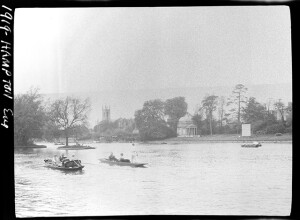 | 1919 | Church of St. Mary (Richmond upon Thames, London, England). | Thames River (England).; Richmond upon Thames (London, England). | 1919 - HAMPTON Eng | Boats and boating–England–London.; Rivers–England–London.; Church buildings–England–London.; Garrick's Temple to Shakespeare (Richmond upon Thames, London, England). | Taken from the banks of the Thames looking across the water, shows three rowboats, each holding 3-4 people. On the far bank is Garrick's Temple to Shakespeare and St. Mary's Church. | MS0003/-001.187#01350 | ||
| 7 | 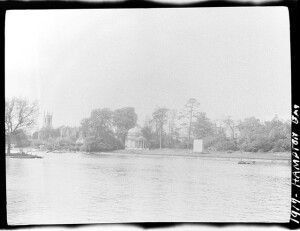 | 1919 | Church of St. Mary (Richmond upon Thames, London, England). | Thames River (England).; Richmond upon Thames (London, England). | 1919 - HAMPTON Eng | Boats and boating–England–London.; Rivers–England–London.; Church buildings–England–London.; Garrick's Temple to Shakespeare (Richmond upon Thames, London, England). | Taken from the banks of the Thames looking across the water. On the far bank is Garrick's Temple to Shakespeare and St. Mary's Church. | MS0003/-001.187#01363 | ||
| 8 | No image URL. | Reproductions of pen drawings on India paper, mounted with mats; each plate has guard sheet with descriptive letterpress. | LB11124 | |||||||
| 9 | No image URL. | Shakespeare, William, 1564-1616. Works. 1921. Cambridge. | "The frontispiece is a reproduction of the title-page of the first folio 1628, containing the Droeshout portrait." General introduction signed: Q; textual introduction: D. W. | LB26376 | ||||||
| 10 | No image URL. | The tempest __ __by William Shakespeare ; illustrated by Birket Foster [et al.] | LB28860 | |||||||
| 11 | No image URL. | Great Britain–History, Naval–Tudors, 1485-1603. | Folger booklets on Tudor and Stuart civilization | Sea-power. | English sea power in the early Tudor period, 1485-1558 __ __by Elaine W. Fowler | LB7518 | ||||
| 12 | No image URL. | Wind Surf. | LB91271 | |||||||
| 13 | 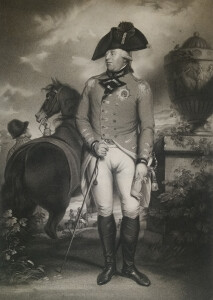 | SHORT DESCRIPTION: Black and white engraving showing entitled “His most gracious majesty King George the Third”. It was published as a part of John Boydell's Shakespeare Gallery in 1804. The artist was Benjamin Smith (1754–1833), a London engraver whom Boydell often commissioned to make engravings. Smith based this work on an original painting by Sir William Beechey (1753–1839) who painted this portrait of George III about 1800. The portrait portrays the king at full length and dressed in his military uniform. NOTES: George III was King of Great Britain and Ireland from October 25, 1760 until January 29, 1820. During his reign many wars were fought including: Seven Years War, American War of Independence, French Revolutionary Wars, Napoleonic Wars, Anglo-Spanish War, Anglo-French War, and Fourth Anglo-Dutch War. | CL567 | |||||||
| 14 | No image URL. | Seven Seas Mariner (Passenger ship : 2001). | Cruise ships. | World's first all balcony ship. | LB84497 | |||||
| 15 | No image URL. | Great Britain–History–Stuarts, 1603-1714 | Folger booklets on Tudor and Stuart civilization | Discoveries in geography–British | Tudor and early Stuart voyaging __ __by Boies Penrose | LB41388 | ||||
| 16 | No image URL. | Spain–Description and travel | Yachting.; Naval art and science–Dictionaries. | A discussion of the authenticity of Shakespeare's plays: p. 208-242. "Vocabulary of sea terms, or nautical phrases": p. 306-332. | LB16859 | |||||
| 17 | No image URL. | Sea in literature | Shakespeare's sea terms explained __ __by W.B. Whall, master mariner | LB29060 | ||||||
| 18 | 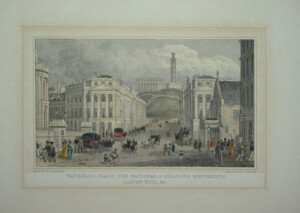 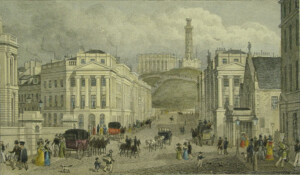 | SHORT DESCRIPTION: Colored steel engraving showing a city scene entitles "Waterloo Plac, The National & Nelson's Monuments, Calton Hill, &c.". The view looks down a road leading ahead towards Calton Hill which is Waterloo Place The view at the top looks to the east from the east end of Princes Street towards Calton Hill (showing the Nelson Monument which is in the shape of an upturned telescope). The building on the far left is Register House and on the right is Shakespeare Theatre. NOTES: Engraving from "Modern Athens" Published by Jones & Co., London, in January 1829. The commentary accompanying the engraving describes Waterloo Place: Waterloo Place: The houses of Waterloo Place are built upon several small arches, and one of larger dimensions, which bear the name 'Regent Bridge'. This crosses the Low Calton, and connects the Hill with the ridge upon which the New Town is chiefly built. The Act of Parliament authorizing the erection of the bridge, and the formation of the road from Princes Street to the Calton, which may be deemed one of the most important of the recent improvements in Edinburgh, was passed in 1814. Waterloo Hotel: On the North side of the street is the Waterloo Hotel, the largest and most splendid establishment of the kind in Edinburgh: amongst other apartments, is a coffee-room 80 feet by 40; and a dining-room of equal dimensions. Theatre Royal: The Theatre Royal, partially represented in the accompanying engraving is marked by its portico, and by statues of Shakespeare, and the Muses of Tragedy and Comedy, placed as acroters to the roof-pediment, and its lateral copings. Situated in such a respectable street, and in connexion, as it is, with several handsome public buildings, this theatre makes a very poor and mean appearance externally, although the interior is fitted up with some degree of attention to the richness of effect. NOTE: Removed from frame 06/12/2008. | CL29407 | |||||||
| 19 | VESSEL INFORMATION-- VESSEL NAME: USS CONSTITUTION VESSEL TYPE: Frigate SERVICE DATES: 1797- SHIP BUILDER: Hartt Shipyard BUILDER LOCATION: Massachusetts, Boston ASSOCIATED PLACE: Massachusetts, Boston VESSEL HISTORY: Built during the years 1794-1797, and was launched October 21, 1797. Cleared for sea on first voyage on July 22, 1798. Ship was rebuilt in 1927-1933 under the direction of Commander John Abel Lord USN . Restorations made 1833-1835, 1855-1860, 1871-1876, 1906, 1927-1931, 1973-1974. MAJOR EVENT: Barbary Wars; War of 1812 CAPTAINS OR OTHER RELATED PEOPLE: Joshua Humphries (designer SHIP OWNERS: US Navy VESSEL DIMENSIONS: 175' (O.A.); 45' (breadth); 20' (depth) | CL630 | ||||||||
| 20 | 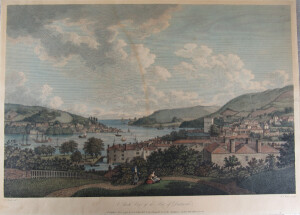 | NOTES: This is the site of the Royal Naval Cadet College since 1905. | CL10739 | |||||||
| 21 | 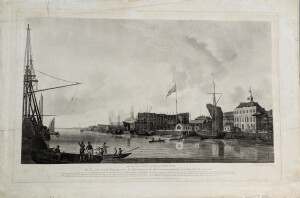 | SHORT DESCRIPTION: Black and white aquatint titled 'The Royal Dock Yard at Woolwich.' Drawn and engraved by Robert Dodd and published by John and Josiah Boydell showing a view of the Royal Dockyard at Woolwich from across the Thames River. The image includes unrigged warships, rowboats, and several ships under construction. One of which appears to be a three decked warship. A Royal Standard flying from the flagmast may be for George III's birthday since there is no sign of a royal visit in progress. The tower in the centre-left background is that of St Mary Magdalene (built 1732-39), still Woolwich parish church today. People in rowing boats in the foreground. NOTES: This is from a set of six images by Robert Dodd showing Royal Dockyards. Published by John and Josiah Boydell, comprising 'A View of the Royal Dockyard at Blackwall' [LP 771] and 'A View of the Royal Dockyard at Deptford' [LP 768] issued on March 25, 1789; 'A View of the Royal Dockyard at Woolwich' [LP 770] and 'A View of the Royal Dockyard at Chatham' [LP 266] issued on October 29, 1789; 'A View of the Royal Dockyard at Plymouth' [LP 775] issued on September 1, 1790; and 'A View of the Royal Dockyard at Portsmouth' [LP 769] on November 1, 1790. According to National Maritime Museum, although Blackwall was a civilian yard, it built many navy ships and Dodd's view of it shows the launch of the 74-gun 'Bombay Castle', a warship built for the Navy as a gift from the East India Company. Presumably it was included to make the project a set of six rather than five. | CL18691 | |||||||
| 22 | 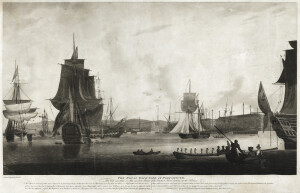 | SHORT DESCRIPTION: Black and white aquatint titled 'The Royal Dock-Yard at Portsmouth' drawn and engraved by Robert Dodd and published by John and Josiah Boydell. The image depicts the Royal dockyard at Portsmouth from abreast of the Common Hard, looking up the harbor. The image shows several warships at anchor but with sails loosed. Several rowboats are in the lower right corner, one with a woman as passenger. In the background are hills at the left and dockyard buildins at the right. NOTES: This is from a set of six images by Robert Dodd showing Royal Dockyards. Published by John and Josiah Boydell, comprising 'A View of the Royal Dockyard at Blackwall' [LP 771] and 'A View of the Royal Dockyard at Deptford' [LP 768] issued on March 25, 1789; 'A View of the Royal Dockyard at Woolwich' [LP 770] and 'A View of the Royal Dockyard at Chatham' [LP 266] issued on October 29, 1789; 'A View of the Royal Dockyard at Plymouth' [LP 775] issued on September 1, 1790; and 'A View of the Royal Dockyard at Portsmouth' [LP 769] on November 1, 1790. According to National Maritime Museum, although Blackwall was a civilian yard, it built many navy ships and Dodd's view of it shows the launch of the 74-gun 'Bombay Castle', a warship built for the Navy as a gift from the East India Company. Presumably it was included to make the project a set of six rather than five. | CL18690 | |||||||
| 23 | No image URL. | Genesee River Region (Pa. and N.Y.) | Geography–Early works to 1800 | Vols. 1 and 2 revised by James Hardie. Vol. 3: 1800. Vol. 4 relates to America and contains Supplement: Description of the Genesee country. | LB26038 | |||||
| 24 | No image URL. | Great Britain–Civilization–17th century; Great Britain–Politics and government–1689-1702; Netherlands–Civilization; Netherlands–Politics and government–1648-1714; United States–Civilization–To 1783; United States–Politics and government–To 1775; Great Britain–History–William and Mary, 1689-1702 | "This volume is published in conjunction with the exhibition held at the Grolier Club (13 December 1988-26 January 1989) and the Folger Shakespeare Library (13 February-15 April 1989)." "A reference encyclopedia and exhibition catalog." | LB7938 | ||||||
| 25 | 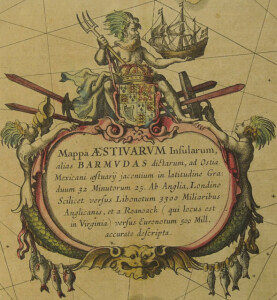 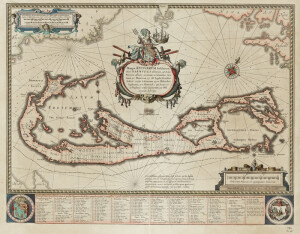 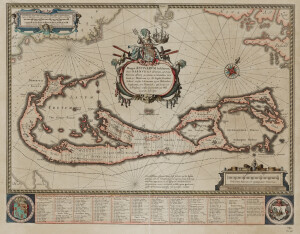 | 1635-1667 | Bermuda Island | "Amstelodami, Guiljelm. Blaeuw excudit." | large ornamental cartouche with Neptune; chart below map lists men with land in Bermuda and their shares. The verso contains French text, indicating this map is from a French edition of either Blaeu's Le Theatre du Monde (published from 1635-1658) or Blaeu's Le Grand Atlas, Volume X (published in 1663 and 1667) From John Gross, ed. Blaeu's The Great Atlas of the 17th Century World (Londoni: New York, 1990), 166, 167.: "Like all seventeenth-century maps of Bermuda, Wilem Blaeu's map is based ultimately on the survey made by John Norwood of the Bermuda Company in 1618 in the form as published by the English mapmaker, John Speed, in 1627. Blaeu's version first appeared a little later, in 1630. Although discovered in 1515 by the Spaniard Juan de Bermúdez, after whom the island was supposedly named, it was the shipwreck of a party of Virginia colonists in 1610 led by Sir George Somers that gave Bermuda its first know inhabitants. Blaeu's Latin title reflects this fact, for Aestivarum Insularum means Summer (or Somers) Islands. The experiences of Somers and his men inspired William Shakespeare, who dispatched Ariel to 'fetch dew from the still-vext Bermoothes' and populated the islands with the cast of The Tempest. The place names and the list of Proprietors given below the map itself all recall the original members of the Bermuda Company, the latter being listed as eight tribes (or parishes): the Marquis of Hamilton, Sir Thomas Smith, the Earls of Devonshire, Pembroke, Warwick and Southampton, William Paget, Sir Edwar Sandys and others including Sir Thomas Russell, Shakespeare's friend and executor. . . . In the upper left-hand and right-hand corners of the map appear the adjacent coasts of the North American colonies of Virginia and New England with, just below the large and ornate centrally placed title cartouche, a tiny outline of Bermuda itself, intended to show its correct proportion and position in the North Atlantic against the mainland. The cartouche incorporates the seated figure of Neptune, the Royal arms, fish and several kinds of navigational instruments in use at the time. The lower corners show the seals of the colony of Viriginia and of Bermuda." Dr. Ir. C. Koeman, Joan Blaeu and his Grand Atlas (Amsterdam: Theatrvm Orbis Terrarvm, 1970). | MSM 1/-#0228 | ||||
| 26 | 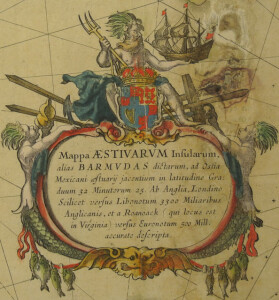 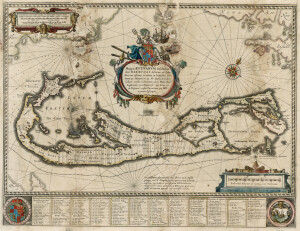 | 1635-1685 | Bermuda Island | "Amstelodami Guijelm. Blaeuw excudit" | 3 ornamental carouches; text below map; mounted on nonarchival board in poor condition. Since the language on the verso cannot be determined, this map could be from any verson of Blaeu's Theatrum Orbis Terrarum (published from 1635-1658) or his Grand Atlas (published from 1662-1685). From John Gross, ed. Blaeu's The Great Atlas of the 17th Century World (Londoni: New York, 1990), 166, 167.: "Like all seventeenth-century maps of Bermuda, Wilem Blaeu's map is based ultimately on the survey made by John Norwood of the Bermuda Company in 1618 in the form as published by the English mapmaker, John Speed, in 1627. Blaeu's version first appeared a little later, in 1630. Although discovered in 1515 by the Spaniard Juan de Bermúdez, after whom the island was supposedly named, it was the shipwreck of a party of Virginia colonists in 1610 led by Sir George Somers that gave Bermuda its first know inhabitants. Blaeu's Latin title reflects this fact, for Aestivarum Insularum means Summer (or Somers) Islands. The experiences of Somers and his men inspired William Shakespeare, who dispatched Ariel to 'fetch dew from the still-vext Bermoothes' and populated the islands with the cast of The Tempest. The place names and the list of Proprietors given below the map itself all recall the original members of the Bermuda Company, the latter being listed as eight tribes (or parishes): the Marquis of Hamilton, Sir Thomas Smith, the Earls of Devonshire, Pembroke, Warwick and Southampton, William Paget, Sir Edwar Sandys and others including Sir Thomas Russell, Shakespeare's friend and executor. . . . In the upper left-hand and right-hand corners of the map appear the adjacent coasts of the North American colonies of Virginia and New England with, just below the large and ornate centrally placed title cartouche, a tiny outline of Bermuda itself, intended to show its correct proportion and position in the North Atlantic against the mainland. The cartouche incorporates the seated figure of Neptune, the Royal arms, fish and several kinds of navigational instruments in use at the time. The lower corners show the seals of the colony of Viriginia and of Bermuda." Dr. Ir. C. Koeman, Joan Blaeu and his Grand Atlas (Amsterdam: Theatrvm Orbis Terrarvm, 1970). | MSM 1/-#0050 | ||||
| 27 | No image URL. | Great Britain–Biography | Renaissance–England. | Based on a series of eight lectures delivered at the Lowell Institute, Boston, in the spring of 1903. cf. Pref. Includes index. | LB7626 | |||||
| 28 | 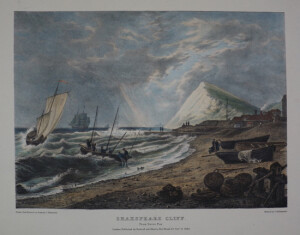 | SHAKSPEARE CLIFF. FROM DOVER PIER [ENGLAND] | CL20433 | |||||||
| 29 | 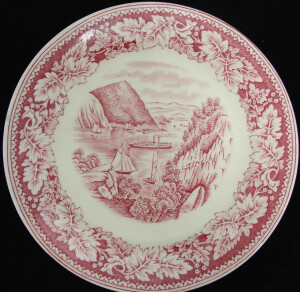 | SHORT DESCRIPTION: Rose color saucer with a view of the Hudson River with steamboat and sailing craft, highlands in foreground and in background and floral design on border on obverse. On the reverse side is an inscription. Manufactured by the Homer Laughlin China Company. The image is based on a view by Currier & Ives. NOTES: [History from Laurelhollowpark.net, maintained by Mark Gonzalez, on the Homer Laughlin China Company] The Homer Laughlin China Company is now known as The Fiesta® Tableware Company. Information from a Homer Laughlin advertisement dated January, 1929: In 1871 Homer Laughlin and his brother, Shakespeare Laughlin, built a two-kiln pottery at East Liverpool, Ohio. This was one of the first plants erected in this country for the making of white-ware. In 1897 Homer Laughlin withdrew from the business, and the present corporation was formed. Since then the growth has been remarkable. A greatly enlarged plant was built in 1899, but in two years this proved inadequate for the growing business, and a third large plant was built in the group at East Liverpool. By 1905 it was again necessary to expand. The great site at Newell, West Virginia was purchased, and the then largest single pottery unit in the world was erected, consisting of thirty kilns under one roof. The business continued to grow rapidly, and in 1914 Plant No. 5, consisting of sixteen kilns, was built at Newell, bringing the total capacity up to seventy-eight kilns. The increasing demand for Homer Laughlin ware necessitated further expansion in 1923, when the continuous tunnel kiln unit, Plant No. 6, was erected. In 1927 a new unit was added, Plant No. 7. On May 25, 1939, Joseph M. Wells informed art director Frederick Hurten Rhead that Montgomery Wards wanted a special line with "printed American patterns." Two weeks later, Rhead went to Chicago, Illinois to meet with Montgomery Wards on the new line and other HLC wares. Later that day, he noted in his journals going to the Chicago Art Museum, Chicago Public Library, and bookstores to hunt for Currier and Ives subjects. On June 11th and 12th, Rhead worked on Currier and Ives treatments to be used on the same shapes as Willow. After meeting with Ed Fry (buyer for Wards) the shapes and patterns were decided upon and work began on the new line on June 19, 1939. Wards offered the line, called Americana, from 1940 until 1956. Each piece has a special Currier and Ives scene with the title is printed in the backstamp in red. The official treatment number for the line was W-2553. An advertisement from the 1950s describes the line as: “...the first ware of its kind to equal the distinguished quality and soft rose-pink color of fine imported ware. Americana has scenes taken from the finest Currier and Ives prints - printed from copper engravings under the glaze so they can never come off.” | CL5035 | |||||||
| 30 | 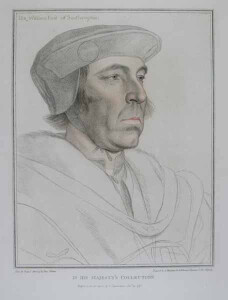 | NOTES: Portrait of William Fitzwilliam, Earl of Southampton, bust-length in three-quarter profile to right, wearing hat and loose gown; after sketch by Hans Holbein the Younger. Plate 71 from "Imitations of Original Drawings by Holbein, in the Collection of His Majesty, for the Portraits of Illustrious Persons in the Court of Henry VIII", by John Chamberlaine. Published London: Printed by W. Bulmer and Company at the Shakespeare Printing Office, 1792 -[1800]. "Imitations of Original Drawings by Holbein, in the Collection of His Majesty" refers to a collection of engraved portraits, primarily by Francesco Bartolozzi, based on the drawings by Hans Holbein the Younger in the Royal Collection. These engravings, published in a large folio volume, were intended to reproduce Holbein's portraits of Henry VIII's court with great fidelity using a stipple engraving technique. The collection was published by John Chamberlaine and included biographical information by Edmund Lodge. According to the Royal Collection Trust: Between 1774 and his death in 1791, Richard Dalton - George III’s first Librarian - had engraved copies of thirty-five of Holbein’s drawings. Thirty-three of these plates were published by W. Richardson in 1792 as The Court of Henry the Eighth; there are loose impressions of a number of subjects in the Royal Collection and the British Museum. The quality of Dalton’s reproductive prints was uniformly poor. On Dalton’s death in February 1791, Chamberlaine was appointed Keeper of Drawings and Medals to the King, working alongside the Librarian, Frederick Augusta Barnard (who assumed the additional responsibility of the drawings and medals on Chamberlaine’s death). The eighty-four plates included in Chamberlaine’s Imitations of Holbein’s drawings were published serially between March 1792 and February 1800; Chamberlaine’s Introduction is dated 4 June 1800, which is the date of the publication of the complete series. The publication appeared in fourteen parts; each part included six plates, with accompanying text by Edmund Lodge, Lancaster Herald. All but four of the plates were engraved by Francesco Bartolozzi, the Florentine engraver transported to England by Dalton in 1764 and ‘bound’ to work for Dalton for the following three years. In 1768 Bartolozzi was appointed engraver to the King; he signed most of his Holbein plates as ‘Historical Engraver to his Majesty’. NOTES: William FitzWilliam, 1st Earl of Southampton, KG (c. 1490 – 15 October 1542) was an English courtier and soldier. Chosen as a companion for Henry Tudor, Prince of Wales (later King Henry VIII of England) and brought up alongside him. After King Henry's coronation in 1509, he was made a Gentleman Usher and King's Cupbearer, and gradually rose at Court. He began his military career at sea, serving under the Marquess of Dorset in 1512, and Sir Edward Howard in the disastrous second attack on Brest where he was injured. Accompanied King Henry VIII to France as an Esquire of the Body, and was knighted on 25 September 1513, the day after the capture of Tournai. William FitzWilliam achieved distinction as naval commander, diplomat, and as government minister. Much of his time as Vice-Admiral (1513–1525) and Admiral was spent keeping the English Channel free from pirates, and he gained praise from Cardinal Wolsey for his initiative in actions against the French. The Earl of Southampton was appointed Lieutenant and Captain-General in the North in 1542, to command an expedition to Scotland, but he was a sick man who had to be conveyed to Newcastle upon Tyne in a litter. Nevertheless, he died in October only three days after his arrival there. See attached file for more complete biography by S. R. Johnson from The History of Parliment Online. | CL18309 | |||||||
| 31 | 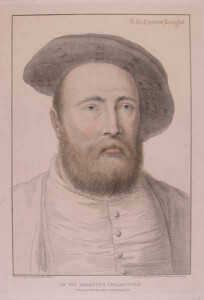 | SHORT DESCRIPTION: Engraving showing a portrait drawing of Sir George Carew (ca 1504-1545), commander of the Mary Rose. The image shows a bust length portrait facing three-quarters to the right. The image is based upon a portrait by Hans Holbein the Younger. The image is plate 21 in the book "Imitations of Original Drawings by Hans Holbein in the Collection of His Majesty" published in London by John Chamberlaine in 1792. The book was printed by W. Bulmer and Company. NOTES: The original drawing is in the Royal Collection Trust. Sir George Carew was a vice-admiral in the British Royal Navy during the reign of King Henry VIII. He died in the sinking of the Royal Navy flagship Mary Rose at the Battle of the Solent during an attempted French invasion in the Italian War of 1542-1546. NOTES: Plate 21 from "Imitations of Original Drawings by Holbein, in the Collection of His Majesty, for the Portraits of Illustrious Persons in the Court of Henry VIII", by John Chamberlaine. London: Printed by W. Bulmer and Company at the Shakespeare Printing Office, 1792 -[1800]. "Imitations of Original Drawings by Holbein, in the Collection of His Majesty" refers to a collection of engraved portraits, primarily by Francesco Bartolozzi, based on the drawings by Hans Holbein the Younger in the Royal Collection. These engravings, published in a large folio volume, were intended to reproduce Holbein's portraits of Henry VIII's court with great fidelity using a stipple engraving technique. The collection was published by John Chamberlaine and included biographical information by Edmund Lodge. According to the Royal Collection Trust: Between 1774 and his death in 1791, Richard Dalton - George III’s first Librarian - had engraved copies of thirty-five of Holbein’s drawings. Thirty-three of these plates were published by W. Richardson in 1792 as The Court of Henry the Eighth; there are loose impressions of a number of subjects in the Royal Collection and the British Museum. The quality of Dalton’s reproductive prints was uniformly poor. On Dalton’s death in February 1791, Chamberlaine was appointed Keeper of Drawings and Medals to the King, working alongside the Librarian, Frederick Augusta Barnard (who assumed the additional responsibility of the drawings and medals on Chamberlaine’s death). The eighty-four plates included in Chamberlaine’s Imitations of Holbein’s drawings were published serially between March 1792 and February 1800; Chamberlaine’s Introduction is dated 4 June 1800, which is the date of the publication of the complete series. The publication appeared in fourteen parts; each part included six plates, with accompanying text by Edmund Lodge, Lancaster Herald. All but four of the plates were engraved by Francesco Bartolozzi, the Florentine engraver transported to England by Dalton in 1764 and ‘bound’ to work for Dalton for the following three years. In 1768 Bartolozzi was appointed engraver to the King; he signed most of his Holbein plates as ‘Historical Engraver to his Majesty’. | CL18310 | |||||||
| 32 | 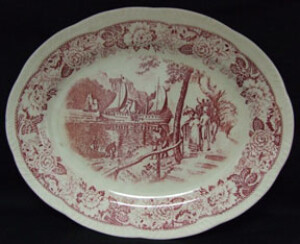 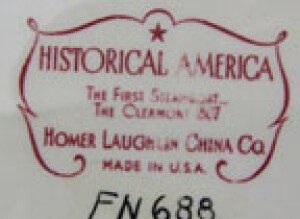 | SHORT DESCRIPTION: Oval ceramic platter with red transferware image of the 1807 steamboat Clermont with two sailing vessels in the background and a group of men and women on a path beside the river in the foreground. Detailed floral border. Scalloped edge. Maker's mark on the reverse side. Manufactured by the Homer Laughlin China Company. The image is based on an artwork by Joseph Boggs Beale. NOTES: [History from Laurelhollowpark.net, maintained by Mark Gonzalez, on the Homer Laughlin China Company] The Homer Laughlin China Company is now known as The Fiesta® Tableware Company. Information from a Homer Laughlin advertisement dated January, 1929: In 1871 Homer Laughlin and his brother, Shakespeare Laughlin, built a two-kiln pottery at East Liverpool, Ohio. This was one of the first plants erected in this country for the making of white-ware. In 1897 Homer Laughlin withdrew from the business, and the present corporation was formed. Since then the growth has been remarkable. A greatly enlarged plant was built in 1899, but in two years this proved inadequate for the growing business, and a third large plant was built in the group at East Liverpool. By 1905 it was again necessary to expand. The great site at Newell, West Virginia was purchased, and the then largest single pottery unit in the world was erected, consisting of thirty kilns under one roof. The business continued to grow rapidly, and in 1914 Plant No. 5, consisting of sixteen kilns, was built at Newell, bringing the total capacity up to seventy-eight kilns. The increasing demand for Homer Laughlin ware necessitated further expansion in 1923, when the continuous tunnel kiln unit, Plant No. 6, was erected. In 1927 a new unit was added, Plant No. 7. NOTES: [History from Laurelhollowpark.net, maintained by Mark Gonzalez, on the Homer Laughlin China Company] In late 1941, the Homer Laughlin China Co. made plans to produce a line which would feature early American scenes reproduced from Joseph Boggs Beale paintings as a Woolworth's exclusive. The new shape was named 'Liberty' probably given to reflect the patriotic theme of the Beale treatments. One of the first mentions in Frederick Hurten Rhead's (art director for the company from 1927-1942) journals regarding the new line occurred on December 23, 1941: 'Mr. J.M. Wells also asked about the subjects for the Beale series. Understand that the series is to be done by the photo-engraved method.' The first Liberty piece modeled was the 9" plate on January 1942. After being accepted, the following items were created from mid-January to early March; 10", 8", 7", 6", plates, tea cup and saucer, sugar, oatmeal, creamer, deep plate, 8" and 9" nappies, 8" baker, and the 12" oval platter. From late March to June, work commenced on creating the various patterns for Liberty. On Monday, June 22, 1942, an entry in Rhead's journals discuss the new treatments: Beale samples out this afternoon. Could be a lot better printing. Most items lack detail and fine tonal variations. Work commenced on improving the quality of the prints, but on July 24, 1942, another change was made - this time with regard to the shape which resulted in a heavier and sharper gadroon edge. In August and September all the existing Liberty shapes were remodeled and a new items was added; the sauceboat. Towards the end of 1942, the revised Liberty shape and the perfected Beale patterns, now called, "Historical America" were put into production. Historical America in red was treatment number W-449 and blue was W-342. Two more items would be added in 1943: the covered casserole in February and the teapot in late March. Historical America was produced for many years and is relatively easy to find in today's market. Red is by far the most common color, but blue examples can also be found. The Liberty shape was also used for decaled lines and other underglaze treatments. It became one of HLC's best selling shapes with production lasting until the 1960s. Historical America will have its own special mark along with the title of the Beale work, but decaled Liberty will carry the general HLC backstamp. Other historical images in the series included: Betsy Ross Showing the First Flag, Benjamin Franklin's experiment, the Arrival of the Mayflower, George Washington Taking Command of the Army, 1775, the Purchase of Manhattan Island, the First Thanksgiving, Barbara Fitchie, the Star Spangled Banner, and Lincoln's Gettysburg Address. | CL5001 | |||||||
| 33 |  | SHORT DESCRIPTION: Watercolor drawing depicting the battle between USS United States and HMS Macedonian on October 25, 1812 by Philadelphia artist George Thresher. The image shows the severely damaged Macedonian at the left with all of her topmasts gone and the remnants of a mast and sail in the water at the center. The United States is at the right firing a broadside towards the British vessel. According to the inscription the watercolor was based upon a drawing that was made on board the United States. Another Thresher image of the battle that was sold at C.G. Sloan in 2004 states that the drawing was made by Commodore Bainbridge. NOTES: The Winterthur Museum has a watercolor of the MACEDONIAN and the USS UNITED STATES by George Thresher (acc#57.821A)...Joseph O. Sands November 13, 1979. The Yale Art University Art Gallery has another version of Macedonian in action with the United States by George Thresher (acc#1946.9.1591). NOTES: [J. Willoz-Egnor, 2/27/2025] Description of the battle between USS United States and HMS Macedonian, October 25, 1812 (compiled from A.T. Mahan, Theodore Roosevelt and William James, see attached files): --These two ships, United States, captained by Stephen Decatur, and the Macedonian, captained by John Carden, had come into contact with each other 8 months before this point in Lynnhaven Bay in what is now Virginia Beach. --When United States arrived in the Bay after a six month cruise, the American’s found HMS Macedonian anchored nearby. --The two captains were frequent dinner companions and at one point had a friendly debate over the relative merits of the 24-pound long guns on Decatur’s frigate versus the 18-pound guns and carronades carried by Macedonian, which had a shorter range but more efficient handling. The result was reputedly a wager for a beaver hat on the outcome of a battle between their respective ships. --Now it was October 25th, 1812 and the winner of the bet was about to be determined. --While Macedonian was cruising between the Azores and Cape Verde islands the masthead reported a large, square-rigged ship about twelve miles away and a few moments later added “A large frigate, bearing down upon us”. --Around 8:30 when the two ships were about three miles apart the British were debating their best course of action. They could steer directly at the enemy ship and close as quickly as possible or they could keep the windward position and use their superior sailing speed to pass the enemy ship at a distance, wear around and then sail up onto the enemy’s stern to limit their exposure to raking fire. --This debate was derailed when the frigate suddenly wore around in the opposite direction and revealed the Stars and Stripes in her tops. --Assuming the American ship was trying to gain the windward position, Carden hauled closer to the wind to keep his windward position. --About 15 minutes later Decatur wore the ship again and put the United States back on her original course although a little farther off. --About 9:00 as the two ship’s passed on a parallel course in opposite directions and about a mile apart, the United States unleashed her main deck battery. --The British didn’t respond and a short time later wore around and headed in the same direction as the American ship. --At the same moment Decatur jogged the United States to starboard to increase his ship’s range. --Although they didn’t realize it at the time, the British had just been placed in a situation that would cost them their ship as Decatur’s maneuvering forced Macedonian to make a long angled approach that exposed the ship to the constant fire of American guns without being able to respond. --Despite the disadvantage Carden pressed on and the American fire immediately began taking out his rig and his crew. --After fifteen minutes of this punishment Carden finally succeeded in getting Macedonian within 100 yards of the American ship but by that point Macedonian’s mizzen topmast, mainyard, maintop sail and most of the standing rigging had been shot away, the lower masts were badly wounded and almost all of her starboard carronade battery were disabled. By contrast the United States had only lost its mizzen topgallant mast. --At this point Decatur backed the mizzen topsail and began pouring broadsides into Macedonian. --After a half an hour Macedonian’s fore and main topmasts fell so the United States redeployed its mizzen topsail, pulled across Macedonian’s bow and sailed away. --Some of the British crew imagined the United States had given up the fight and began cheering. Yes, the American’s were stopping the fight, but only because they knew the contest was over. --When the American ship returned about an hour later Macedonian’s mizzen mast had gone overboard, she had 95 holes in her hull and seven feet of water in her hold, and one-third of the crew was dead or wounded (43 killed, 61 wounded). --When the United States took up a raking position Carden had no choice but to surrender. --There were only 7 dead and 5 wounded on United States and only 5 hits in her hull. --The destruction of Macedonian’s rig was due primarily to the fact that Decatur wanted to keep his prize intact and had ordered his crews to fire at the British ship’s rig with chain, linked and double headed bar shot in the opening stages of the battle. --The intensity of the United States’s fire is relayed by the story that at one point during the battle the volume of fire and smoke coming from the American ship was so intense, the British believed the American ship was on fire. They were disabused of this notion when the next full broadside smashed into them. | CL629 | |||||||
| 34 | 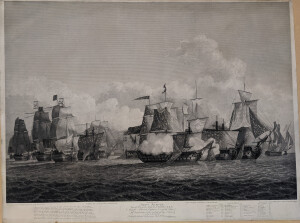 | ADDITIONAL INFORMATION: Parker-Cust, "Naval Battles", p. 128. NOTES: [Royal Naval Museum website, June 2004] On the 14th February 1797 Nelson played a prominent role in the battle of Cape St. Vincent, when Sir Jervis's fleet fought a larger but operationally inferior Spanish fleet. During the battle, Nelson took his ship out of the line of battle to attack a group of Spanish ships. Four were taken as prizes. Nelson led a boarding party that captured two ships the San Nicholas and San Josef, and personally received the surrender of a number of Spanish officers. Six days after the battle he was promoted Rear Admiral of the Blue; he was also awarded the Knight Commander of the Bath for his courage and skill in battle, and given the honorary rank of Colonel of Marines. | CL17049 | |||||||
| 35 | 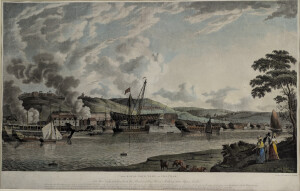 | SHORT DESCRIPTION: Hand-colored engraving titled 'The Royal Dock Yard at Chatham,' artist Robert Dodd, published by John and Josiah Boydell. Dockyard scene depicting a view of Chatham dockyard from across the River Medway. Numerous ships, including a sheer hulk, in the center, and a land mass with cattle, two women and and a man in the foreground. Two plumes of smoke are seen coming from the buildings in the background and ships in various stages of construction and repair. NOTES: This is from a set of six images by Robert Dodd showing Royal Dockyards. Published by John and Josiah Boydell, comprising 'A View of the Royal Dockyard at Blackwall' [LP 771] and 'A View of the Royal Dockyard at Deptford' [LP 768] issued on March 25, 1789; 'A View of the Royal Dockyard at Woolwich' [LP 770] and 'A View of the Royal Dockyard at Chatham' [LP 266] issued on October 29, 1789; 'A View of the Royal Dockyard at Plymouth' [LP 775] issued on September 1, 1790; and 'A View of the Royal Dockyard at Portsmouth' [LP 769] on November 1, 1790. According to National Maritime Museum, although Blackwall was a civilian yard, it built many navy ships and Dodd's view of it shows the launch of the 74-gun 'Bombay Castle', a warship built for the Navy as a gift from the East India Company. Presumably it was included to make the project a set of six rather than five. | CL17672 | |||||||
| 36 | 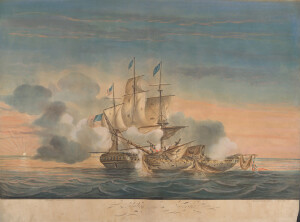 | SHORT DESCRIPTION: Watercolor drawing by George Godsell Thresher titled "Constitution and Guerriere." The image shows the battle August 19th, 1812 battle between USS Constitution and HMS Guerriere. The image shows the HMS Guerriere completely dismasted with its sails draped across the decks and in the water. USS Constitution can be seen behind her with minimally damaged sails. Smoke from cannon fire surrounds the two vessels. The sun is setting on the horizon at the left. NOTES: On August 19th, 1812 while sailing off the coast of Halifax, Nova Scotia, USS Constitution (44-guns), captained by Isaac Hull, spotted a sail on the horizon and immediately steered to intercept it. The ship turned out to be HMS Guerrière (38-guns), captained by James Richard Dacres, who was taking his ship to Halifax for refitting. Dacres has Guerrière lying in the hove-to position and was in a position to rake the fast approaching and obviously hostile USS Constitution. Just after 5:00, with the range between the two vessels about a thousand yards Guerrière fired a starboard broadside, but the shot fell short. Dacres wore the ship around and fired a port broadside but with a heaving sea (which threw off their aim) and the approaching enemy yawing (Hull was swerving Constitution back and forth across her course in order to minimize their chances of being raked from stem to stern) only two of the shot struck home. Constitution held the weather gauge so Dacres turned Guerrière around and also ran with the wind. Both ships were running under “fighting sail” (topgallants only) until Hull set Constitution’s main course which gave the ship a burst of speed and allowed Hull to pull even with Guerrière. The two ships began a running fight trading broadsides. While the British fired on the uproll to tear up Constitution’s rigging, the American’s fired on the down roll punching holes in Guerrière’s hull. Constitution was not only larger, but her 24-pound cannon threw a heavier weight than the British 18-pounders. In many instances, the solid shot being used by the British simply bounced off Constitution’s thick oak planking (leading to her nickname “Old Ironsides”). Guerrière’s mizzenmast soon came down which slowed the ship’s momentum while Constitution, with all sails set, surged across her bow and let loose a raking broadside. Hull instantly wore Constitution and raked the British again. Sailing too close, the two ships became entangled. Both ship’s formed boarding parties while marines did their best to clear the decks of men. Guerrière’s gun crews ran cannons through the windows of Hull’s quarters and the resulting blasts started a fire but it was quickly extinguished. Just as the two ships began pulling free of each other both Guerrière’s foremast and mainmast came down which took down all of the ship’s rigging except the ship’s bowsprit. At this point the guns fell silent as Guerrière was a dismasted hulk. Dacres had no choice but to surrender. In heavy seas, it took all night for Constitution’s boats to transfer Guerrière’s crew from the badly listing ship. The following morning Hull determined there was no way to get Guerrière into port so he transferred the surviving sick and wounded and then set the vessel on fire. Shortly afterwards the fire reached Guerrière’s magazine and the ship exploded and sank. Guerrière had 23 killed and 56 wounded. Constitution only suffered 14 casualties. VESSEL INFORMATION-- VESSEL NAME: USS CONSTITUTION VESSEL TYPE: Frigate SERVICE DATES: 1797- SHIP BUILDER: Hartt Shipyard BUILDER LOCATION: Massachusetts, Boston VESSEL DESIGNER: Joshua Humphries SHIP OWNER: U.S. NAVY ASSOCIATED PLACE: Massachusetts, Boston VESSEL HISTORY: Built during the years 1794-1797, and was launched October 21, 1797. Cleared for sea on first voyage on July 22, 1798. Ship was rebuilt in 1927-1933 under the direction of Commander John Abel Lord USN . Restorations made 1833-1835, 1855-1860, 1871-1876, 1906, 1927-1931, 1973-1974. MAJOR EVENT: Barbary Wars; War of 1812 CAPTAINS OR OTHER RELATED PEOPLE: Joshua Humphries (designer SHIP OWNERS: US Navy VESSEL DIMENSIONS: 175' (O.A.); 45' (breadth); 20' (depth) | CL6576 | |||||||
| 37 | 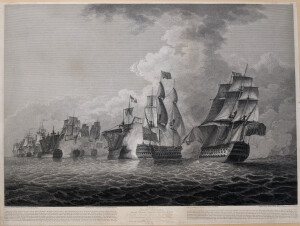 | ADDITIONAL INFORMATION: Parker-Cust, "Naval Battle", p. 128. NOTES: Duplicate image 1986.59.11 | CL17053 | |||||||
| 38 | 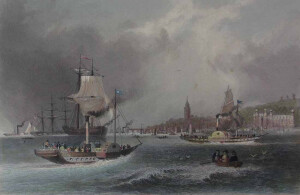 | SHORT DESCRIPTION: The image depicts several side paddle wheel steamboats in the harbor at Gravesend, one of which is named Vesper. They each have a blue swallowtail flag with a white circle. In the background are several large sailing vessels; one ship has a red and white pennant. In-between the two steamboats in the foreground is a long boat with three people rowing along the harbor and birds flying around them. In the background is the city of Gravesend with buildings lining the waterfront. At the farthest end of the visible city is Gravesend Pier. The spire of St. George’s Church towers over the buildings, and in the distance there is a hill with a windmill on top. The building on the far right with high arches and onion domes on the tops of the towers is the Clifton Baths and Terrace. NOTES: Bathing machines existed in Gravesend as early as 1796, but the Clifton Baths were farther back from the waterfront until 1837 when the building with the “pseudo oriental architecture” was built. The pier in the distance is still in existence, the oldest remaining cast iron pier. Designed by William Tiernwey Clark, it opened in 1834 in the same location as the original town quay. After opening, the pier quickly serviced millions of passengers on steam packet ships to London until the opening of the railroad. St. George’s Church was licensed for worship in 1497. The church burnt on August 24, 1727 and was rebuilt between 1731 and 1732. The church has expanded and changed over the years, but the tower that is visible in the print is from the 1732 building. NOTES: The image is from before page 189 of the appendix of volume 1 of “The Ports, Harbours, Watering-Places, and Coast Scenery of Great Britain," published by George Virtue in 1842. (TMMP Library DA625 .F49 Rare) The book was first published in 1838 by Charles Tilt with descriptions by William Andrew Chatto. It was then published several times in 1839 and 1842 by George Virtue, and later after 1855 by Virtue & Co. under George’s son, James S. Virtue. The name also changed slightly, but kept the "Ports, Harbours, and Watering Places" part of the title. The books that the Virtues published kept Chatto’s descriptions for the first volume, but they expanded the book to two volumes. William Beattie wrote the text for the new second volume and an appendix added to the end of the volume 1. NOTES: From the end of the 1842 edition of Volume 2: “In taking leave of these two Volumes, illustrating the Ports, Harbours, Watering-places, and Coast Scenery of Great Britain, a few words of explanation appear necessary. The work was originally commenced by Messrs. Finden [William and Edward], and for some time carried on with all the taste and spirit characteristic of these distinguished Artists. But the remuneration accruing from the sale being found inadequate to defray the expenses incurred in its production, it was offered to the present Publisher, who readily saw the improvements of which it was susceptible and became the purchaser. Arrangements were then made for its continuation. Mr. BARTLETT, whose illustrations are so familiarly and favourably known to the Public, set out on a tour of observation along the northern coasts of England and Scotland; and, after visiting every locality indicated, returned with a portfolio of drawings taken on the spot. These were immediately placed in the hands of eminent engravers; a re-issue and continuation of the work were announced; and it is gratifying to state, that the reception which it has since met with from the Public has been most liberal. With regard to the letterpress descriptions, I beg it to be expressly understood that the labours of my pen have been confined to the Second Volume and the Appendix of Vol. 1. The First Volume was written under the signature W.A.C. - prior to my connexion with the work; and, in justice to that author, I feel it at once a duty and a pleasure to conclude the work with this statement. William Beattie, M.D.” January 1842 J. Rickerby, printer, Sherbourn Lane NOTES: Excerpt from “The Ports, Harbours, Watering-Places, and Picturesque Scenery of Great Britain” “The great facilities of communication with the metropolis, the salubrity of the air, the beauty of the surrounding scenery, and the public amusements by which it is enlivened, have all contributed to render Gravesend the most frequented town on the river Thames. The thousands of visitors who here keep holiday during six or eight months of the year, have insured resources to the inhabitants more to be depended on than the fluctuations of trade. New houses, new streets, hotels, reading-rooms, public baths, and pleasure-gardens, have all appeared in succession since the introduction of steam on the river, and now present attractions rarely to be met with in any island or maritime town of like size. The harbor, generally enlivened by East and West Indiamen at anchor; the incessant passing and repassing of steamers to every part of the coast and kingdom; with private yachts and pleasure boats skimming past, or lying off the piers, with their holiday freight of joyous citizens, give a never failing interest and spirit to the whole picture; and present, in a short sojourn at Gravesend, more animation and variety than is to be met with at any other part of the river. The rides and drives inland are highly varied and picturesque. Cobham Hall- the ancient seat of Lord Darnley- and its magnificent park-scenery, with the village and ancient church adjourning, are objects that well repay a summer-day’s excursion. Springhead, famous for the water cresses which it supplies to the London markets, is one of the most rural and picturesque retreats in Kent; while Gad’s-hill, to which Shakespeare has given immortality, as the scene of the robbery of the Sandwich merchants, said to have been perpetrated by Henry the Fifth,- when Prince Hal- and his dissolute companions, is within an easy walk. Windmill-hill, the highest object in the background of the picture, is proverbially famed as commanding one of the finest panoramic views in the country." | CL16420 | |||||||
| 39 | 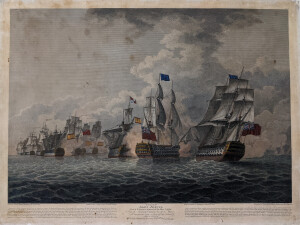 | LABEL COPY: Battle of Cape St. Vincent, 1797 Lt. Jahleel Brenton, artist James Fittler, engraver Gift of Mr. James E. Jewell 1986.59.11 Seeing a gap in the Spanish line, Nelson disobeyed the Fighting Instructions and drove his ships through the Spanish, a tactic he would refine at Trafalgar. (Nelson 6-26-98) LABEL COPY: ...Representation of the Sea Fight off Cape St. Vincent... Engraving, Gift of Mr. James E. Jewell 1986.59.11 Nelson openly violated the Fighting Instructions by breaking from the traditional line of battle and charging the Spanish vessels off the coast of Portugal, February, 1797. Personally directing his boarding parties, Nelson captured SAN NICOLAS and SAN JOSEF. (Nelson, Sec. D, 10-1-92, page 6) NOTES: Duplicate image LE 2593 | CL22292 | |||||||
| 40 | 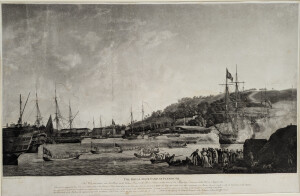 | SHORT DESCRIPTION: Black and white aquatint titled 'The Royal Dock Yard at Plymouth.' Drawn and engraved by Robert Dodd and published by John and Josiah Boydell. A view of the royal dockyard at Plymouth taken near Torr Point, on the Western Bank of the River Tamer during a visit by King George III. The print commemorates the royal visit and celebrates the growth of the dockyard as a testament to the increasing grandeur of the Royal Navy. The text below the image claims the dockyard's productivity to be superior to all other dockyards in the Kingdom and the world. A crowd gathers in the dock in the right foreground to witness the King. Men in rowboats fly royal ensigns and ships perform salutes in honor of the King. NOTES: From the webste morethannelson.com, The King's Naval Review at Plymouth, August 1789, by Richard Hiscocks, August 22, 2018: During the latter part of 1788 the health of King George III had been deteriorating as he continued to suffer from a disturbing condition that could not be diagnosed at the time, but which symptoms included a tendency to irrational behaviour and speech, repetitive verbosity, breathing difficulties, acute stomach pains, insomnia, and a foaming of the mouth. Rumours were soon afoot that he had completely lost his senses, and whilst his physicians stumbled from one hopeless remedy to another the government trembled at the thought that they might be required to ask his dissolute and radical son, Prince George, to assume the Regency. Then as the new year of 1789 dawned the King began to show signs of improvement, and within a couple of months he was deemed to have made a full recovery. To celebrate the poplar monarch s return to good health it was decided that he and his beloved wife, Queen Charlotte, should take a holiday at Weymouth with their daughters, and that a frigate, the Southampton 32, Captain Andrew Snape Douglas, together with a sail of the line, the Magnificent 74, Captain Richard Onslow, should be put at his disposal. Whilst in the West Country a visit by Their Majesties to Plymouth was arranged where a review of the naval facilities would be undertaken, and where a mock naval battle would also be staged for their delectation. Accordingly the royal family and their attendants left Weymouth to travel overland to Saltram House near Plymouth where they arrived on the afternoon of 15 August. The review of the dockyard facilities began at 11 a.m. on 17 August when the royal party consisting of the King, Queen Charlotte, and three of their daughters arrived at Plymouth to be saluted by the garrison, the rampart cannons, and the fort. They were then received by a host of notables including the dockyard commissioner Captain John Laforey, the King s great friend the Earl of Chesterfield, the first lord of the Admiralty Earl Chatham, the previous first lord of the Admiralty Earl Howe, and other members of the Board of Admiralty including Vice-Admiral Lord Hood. After taking refreshment the royal party went on board the the brand new Impregnable 98, Captain Thomas Byard, which was flying the flag of the commander-in-chief at Plymouth, Rear-Admiral Sir Richard Bickerton, an officer who on a previous fleet review in 1778 had been knighted for the honour of steering the King s barge. As the King stepped aboard the Impregnable the other ships in the port and in Plymouth Sound opened up with their own salute, and this was answered by the cannon on the Citadel and by a number of smaller installations, as well as a visiting Dutch man-of-war, the Lynx. After remaining aboard the Impregnable for upwards of an hour Their Majesties took their leave and returned to the shore in the royal barge, their progress being somewhat incongruously attended by a cutter crewed by seven young women resplendent in white gowns and black bonnets. Further time was spent in the dockyard before the royals left for Saltram House accompanied by a flotilla of boats, and being saluted all the way to their destination. Sadly the day was marred when a sloop carrying a number of spectators overturned and four women and a child were reportedly drowned, although when the King was made aware of the incident he quickly declared that any children orphaned by the disaster would be provided for. At 9 am the next day, 18 August, in fine clear weather and to a cacophony of salutes from the military installations ashore and ships in the harbour, the King, Queen and princesses were rowed out in Commissioner Laforey s barge to the Southampton, which was moored in Plymouth Sound having recently arrived from Weymouth with Lord Chatham and his party. The royal barge was preceded by Rear-Admiral Bickerton in one barge and Lord Chatham and Vice-Admiral Lord Hood in another, and its progress was acclaimed by a host of spectators gathered on the shore. An hour and a half after receiving the royal party the Southampton put to sea on a south south-easterly wind to be followed by the Magnificent and the frigate Lowestoffe 32, Captain Edmund Dod, the three men-of-war being accompanied by a hundred other vessels including the Duke of Richmond s yacht with a band in full swing. Shortly afterwards a sail of the line appeared from behind the Staddon Heights on the eastern side of the Sound, standing in on the larboard tack with the benefit of a gentle easterly breeze, and as the Southampton weathered the Mewstone a further six sail of the line, two frigates and two cutters came into view. This force was Commodore Samuel Granston Goodall s Squadron of Observation which, to some French concern, had recently been parading in the mouth of the Channel. When the Southampton came within half a mile of Goodall s ships a royal salute of twenty-one guns was fired by every vessel, whereupon the larger men-of-war, which were in line ahead and about two cable lengths apart, tacked out to sea and split into two divisions so as to begin the evolutions that would enable them to bring about a realistically mock action. Leading the line of four ships that constituted the supposed enemy force, and would be ironically cast as the French by the eager spectators, was the Cumberland 74, Captain John MacBride, and she was followed by the Bellona 74, the frigate Hebe 38 and Bedford 74. These vessels, which were otherwise identified by their white colours, assumed a line to leeward on the larboard tack and backed their topsails to allow Commodore Goodall s pennant ship Carnatic 74 at the head of His Majesty s force to bear down and attack them. She in turn was followed by the Orion 74, Director 64, and Goliath 74. The Carnatic took up a position abreast and at musket shot of the rear ship in the French line, this being the Bedford, the signal for battle was made, and as a furious gunfire began the other ships of Goodall s division came down with the wind to take their positions abreast of each enemy vessel. With the Magnificent and Lowestoft also joining the fun a staged battle began whilst the Southampton lay close by to windward in the east, flying the Royal Standard at the main mast, the Admiralty flag at the foremast, and the Union flag at the mizzen. As the action progressed MacBride s French squadron appeared to have the worst of it, and after some thirty minutes the remainder of his ships wore and tacked to larboard as if to effect repairs whilst his own command, the Cumberland, covered them by engaging three of the enemy. The action then resumed on the starboard tack and continued for a good hour and a half, with several of the vessels feigning damage aloft by letting go their topsail sheets as if to signify that their rigging had been shot away. This more belligerent phase of the action continued until about 3 p.m. when MacBride was obliged to strike his colours. At the conclusion of the engagement the Southampton made sail and took up a position to leeward of the lines of battle, and in succession Goodall s ships passed under her stern with their yards fully manned, firing another 21-gun salute and letting fly their topsails as they did so. The King, who had been in conversation with Lord Chatham and Lord Hood throughout the mock action, expressed concern for the safety of the men of the Orion at her mastheads, and appeared somewhat relieved when they descended without injury. He was also intrigued when the Cumberland passed by, for her starboard ports were manned by a number of Negroes dressed in white and sporting turbans. The captains then took to their barges to kiss hands with the King, following which the Southampton stood back into the Sound under the escort of the fleet in line ahead until at 4 p.m. Goodall made the signal for his ships to put about and head back out to sea. By 7 o clock in the evening the royal party was back at Saltram House, having spent eight hours on the water. Next day the inquisitive King rose early to return to the dockyard, his first stop being the Victualling Office where he demanded to taste a ships biscuit, and where he ordered a cask of beef to be opened so that a piece could be sent to Saltram for his dinner. Visits to the Lower Fort, the Citadel, ramparts, storehouses and underground works followed with the military officers in attendance, and he then went to the gun wharf to inspect the ordnance. Thereafter several days of non-official business were enjoyed before on the morning of the 22nd Their Majesties left Saltram House to return overland to Weymouth, whilst Lord Chatham and a number of other notables rejoined the Southampton and set sail for the same port. NOTES: From the Bury and Norwich Post, August 26, 1789, page 1: Saturday's Post. LONDON. NAVAL REVIEW at PLYMOUTH. About nine o’clock on Tuesday morning their Majesties, the Princesses, and suite, arrived at the Dock-yard from Saltram; from whence they rowed in barges to the Sound, where they embarked on board the Southampton, attended by the Magnificent of 74 guns, and immediately proceeded to sea, with the wind S. S. E. to meet the fleet of Commodore Goodall, of eight sail of the line, then standing into the Sound, in a line of battle a-head on the larboard tack. On the approach of the Royal Standard, the fleet saluted with 21 guns each; and tacked, and stood to sea, under an easy sail, followed by the Royal Frigate.—Soon after which the signal was made for a division, meant to represent the enemy fleet (consisting of the Cumberland, Bellona, Hebe, and Bedford) to bear and form to leeward, which they accordingly did, led by Capt. M’Bride. the Cumberland, under White Colours. The Commodore then made the signal for his own division (led by the Carnatic) to bear down and attack the enemy, opposing himself to the sternmost ship (the Bedford) in the enemy’s line. Soon after which he hoisted the signal for battle, and opened his cannonade; while the rest of his squadron approached their respective opponents to windward. The cannonade now appeared general in both lines. Several manoeuvres then took place, till a signal to desist firing, and bring the Commodore to bear N.E. terminated the action. During these different evolutions, the Royal Family, in the Southampton, were lying to, to windward, close by the scene of action. The day was very fine, with a steady breeze, and clear atmosphere, and the ocean covered with vessels of different kinds. The Royal Frigate now made sail, and bore up to leeward of the Line, and brought to; when the ships in succession (led by the Commodore) passed under her stern, and manned ship, cheered, and saluted with 21 guns each. The Royal Frigate, after receiving the personal compliments of the Commodore, and all the Captains in their barges, filled and stood into the Sound, escorted by the whole fleet in a line a-head. At four o’clock the fleet took leave of the Royal Standard, by general salute, tacked, and stood to sea. NOTES: The yard was known as HM Dockyard, Plymouth until 1843, when it was renamed HM Dockyard, Devonport. NOTES: This is from a set of six images by Robert Dodd showing Royal Dockyards. Published by John and Josiah Boydell, comprising 'A View of the Royal Dockyard at Blackwall' [LP 771] and 'A View of the Royal Dockyard at Deptford' [LP 768] issued on March 25, 1789; 'A View of the Royal Dockyard at Woolwich' [LP 770] and 'A View of the Royal Dockyard at Chatham' [LP 266] issued on October 29, 1789; 'A View of the Royal Dockyard at Plymouth' [LP 775] issued on September 1, 1790; and 'A View of the Royal Dockyard at Portsmouth' [LP 769] on November 1, 1790. According to National Maritime Museum, although Blackwall was a civilian yard, it built many navy ships and Dodd's view of it shows the launch of the 74-gun 'Bombay Castle', a warship built for the Navy as a gift from the East India Company. Presumably it was included to make the project a set of six rather than five. | CL18696 | |||||||
| 41 | 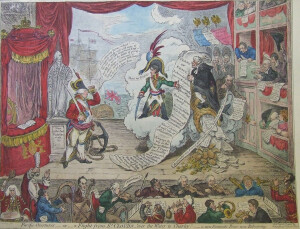 | SHORT DESCRIPTION: [Pulled from identical image at The British Museum] The stage, flanked by the stage-boxes, extends across the design, the base of which is the orchestra, where the new Ministry perform. George III has stepped on to the stage from the royal box (left) and confronts Napoleon, who stands arrogantly upon clouds and points to an enormous scroll held up by Talleyrand. This stretches across the cloud to rest on the stage. The Emperor, in uniform, with spurred jackboots and wearing a large, feathered bicorne, holds a sword in his right. hand and says fiercely: "There's my Term's." The King, who wears uniform with a small cocked hat and buckled shoes, holds his sword against his shoulder. He inspects the scroll through his glass, saying: " - Very amusing Terms indeed! - and might do vastly well with some of the new-made little Gingerbread kings - but WE are not in the habits of giving up either "Ships, or Commerce, or Colonies", merely because little Boney is in a pet to have them!!!" The scroll is inscribed: 'TERMS OF PEACE - Acknowledge me as Emperor - "mantle your Fleet, - Reduce your Army - Abandon Malta & Gibraltar, - Renounce all Continental Connection - Your Colonies I will take at a Valuation, - Engage to pay to the Great-Nation for 7 Years annually £1.000.000. and Pace in my Hands as Hostages the Princess Charlotte of Wales, with Ten of ye late Administration whom I shall name.' Talleyrand kneels on one knee, displaying a deformed left leg, on a cornupia which rests on the clouds that support Napoleon. He wears a long gown with a rosary (denoting the ex-Bishop of Autun); a pen is behind his ear. From the cornucopia papers, money-bags, and coin pour down on to the stage. The papers are: 'Address to the Papists'; 'Loan to the - ['Prince' implied]; 'To the United Irishmen'; 'To the London Corresponding Society'; 'The Press'; 'The Argus'; 'For the Whig Club'; 'To the Army; 'To the Navy', 'To [the] Volunteers'. Money-bags are labelled: 'Maynooth [word illegible]', 'Horne Tooke', 'Morning Chronicle', '[Cobbett's] Weekly Register', 'Thelwall.' Immediately behind Talleyrand, and also on the Napoleonic clouds crouch Arthur O'Connor, looking down conspiratorially at Fox in the orchestra below. His words extend in a long label towards Fox: "Remember m Friend your Oath, - " Our Politicks are the same!"" He holds a paper: 'at Maidstone Not Guilty - N.B - my Confederate Quigley only, was Hanged there.' Behind Talleyrand and O'Connor three desiccated corpses wearing French Grenadier's uniform hold up three eagles to each of which a banner is attached: 'Army of England', 'Army of Ireland', 'Army of Scotland'. Their caps are decorated with an 'N' surmounted by a crown. Behind them bayonets recede in perspective, their holders hidden by the peace scroll. Most of the orchestra sit facing each other at a long desk whose slopes hold their music. At its head (left) sits Grenville, the First Violin, saying "Attention!"; in his pocket is a paper: 'Broad Bottom Concert'; his music is 'Britons Strike Home'. Facing him at the opposite end sits Moira, very erect, blowing a trumpet; his music is 'See the Conquering Hero comes'. Four performers sit on each side; nearest the stage and on Grenville's left, sit (left to right) Fox, with a violin, pausing with extended bow to look up at O'Connor; his music is 'God save the King'. Next him is Lord Spencer, playing a violin, but without music Windham, also playing a violin, his music is 'Cheese Parings'. Next, and on Moira's right, Sheridan, fat and bloated, sleeps with folded arms, clasping a bassoon; his music is 'The Midwatch' [for Sheridan as the sleeping watchman]. The others, facing the stage, turn their heads in profile. Little Lord Henry Petty, on Grenville's right, wearing his Chancellor's gown, plays the triangle; his music is 'the little Jesuits Jig' [he is the son of 'Malagrida'; for 'jig']. Next Sidmouth performs on a clyster-pipe; his music is 'Water-Gruel' . Lauderdale blows the French horn, his music is 'Brissots Delight'. Tierney, self-absorbed, plays two pipes: one inscribed 'Grenville' the other 'Fox'; his music is 'How Happy could I be with either', with another paper headed 'Borough' [he was M.P. for Southwark, and regarded as eager for office under any Government]. The rest of the orchestra are on the left, behind Grenville's back. On the extreme left. Erskine, the egotist, full face, regardless of the others, beats a drum with the mace. Lord Ellenborough stands as if conducting, holding up a rolled document: 'Bill of Indemnity' [the Bill for giving indemnity to witnesses against Melville, it was opposed by Ellenborough,'Parl. Hist.' vi. 248 f.]. Bedford plays the harp: 'Harp of St Patrick'. In his pocket is 'a Serious Ballad Burke to Duke' [Burke's 'Letter to a Noble Lord' was to his brother]. Grey, his music 'Rule Britannia', hanging over the back of Grenville's chair, plays the 'cello. The royal box is sumptuously draped, and surmounted with a crown and crossed sceptres, with the inscription: 'Ge IIId | whom God long preserve'. Behind his empty chair is the pompously projecting stomach with Garter ribbon, and hand holding the wand of the Lord Chamberlain, Lord Dartmouth. On the front of the box lies an open book: 'Shakespeare - I know You all.' Next the box and immediately behind the King is a lifelike statue of Pitt, wearing (like Petty) the gown of the Chancellor of the Exchequer. One hand rests on a pillar inscribed 'Integrity'. The high pedestal is inscribed 'Non sibi sed Patriae vixit' [the motto on the badges of the Pitt Clubs which came into existence on Pitt's death. Broadley, i. 242]. Beside the King is an anchor and rope. At the back of the stage, behind the King, is the sea with a man-of-war in full sail: 'The Royal Sovereign'. On the r. are four stage-boxes. On the level of the stage the Prince and Mrs. Fitzherbert sit gazing at each other; he holds his cocked hat, she has a fan with the Prince's feathers and holds a playbill: 'Shortly will be Perform'd the Farce Dolly made a Dutchess.' In the box immediately above are Horne Tooke (in clerical dress) and his friend Burdett, holding up his cocked hat. Both applaud vigorously, saying respectively 'Bravissimo!' and 'Bravo'; they look towards Talleyrand and Napoleon. The former's playbill is 'Duet on a Pair of Portraits', the latter's 'The Brentford Bully, a new Song - Liberty and Equality down with all the Prisons'. Over this box are the Prince's feathers. Next it, and above the door leading to the stage, is a small box from which Grattan leans delightedly, his playbill is 'Irish-Jig - Report of the secret Committee - Neilson told me he had Sworn Mr Grattan.' Above Grattan, in a small box at the upper edge of the design, are the Duke of Clarence and Mrs. Jordan, both grossly caricatured. Their playbill is 'Jobson & Nell' [the cobbler and his wife in 'The Devil to Pay']. 5 April 1806 Curator's comments: (Description and comment from M.Dorothy George, 'Catalogue of Political and Personal Satires in the British Museum', VIII, 1947) The Ministry's peace overtures (which began in March, and continued after Fox's death on 13 Sept.) are associated with Jacobinism, sedition, and treason, and especially with Franco-Irish intrigue and the relations between Fox and O'Connor. Fox's evidence at Maidstone (May 1798) was: 'I always thought Mr O'Connor . . . attached to the principles and the constitution of this country, upon which the present family sit upon the throne, and to which we owe all our liberties'. O'Connor (whom Fox met in France) at this time was a general in the French service. For 'The Press', organ of the United Irishmen; for 'The Argus', a propagandist paper in English, printed in Paris, see BMSat 9998. Napoleon is charged with financing English and Irish Jacobins, and even the anti-Pittite Press, i.e. the 'Morning Chronicle' and 'Cobbett's Political Register', though Cobbett had maintained the dangers of a popular demand for peace, and recently asserted that a tolerable peace was unattainable 'until we have a real army'. 'Pol. Reg.', 8 Feb. (ix. 167). The allusion to Maynooth is obscure, and is probably due to Gillray's hatred of 'Popery'. The seminary was founded in 1795 by an Act of the Irish Parliament: the first move towards an additional grant was a suggestion by Petty to Grenville, 25 Apr. 1806 ('H.M.C., Dropmore MSS.' viii. 120 f.), not carried out till after Fox's death. The divisions in the new Ministry, &c, are suggested by each man's absorption in a separate tune. There is a second state, the Prince of Wales altered to Lord Derby, it is said on account of the offence given to the King by the Prince's association with Mrs. Fitzherbert. The play-bill is altered to: 'the Farce Darby a Duke & Joan a Duchess'. This state was reprinted in 1830 and 1851. Grego, 'Gillray', p. 330 f. (reproduction). Wright and Evans, No. 314. Reprinted, 'G.W.G.', 1830. Broadley, i. 241 f. Reproduced, Grand-Carteret, 'Napoléon', No. 163. | CL16343 | |||||||
| 42 | SHORT DESCRIPTION: Black and white engraving titled ‘LONDON’. The attributed engraver is Claes Jansz Visscher (1587-1652) most likely after a drawing by Jodocus Hondius (1563-1612/3). Visscher’s name does not appear on our engraving but it is nearly identical to his view of London that was published in 1616, the only exception being that the left-hand sheet is missing. Our engraving has not been clipped, there is a clear border wrapping the entire image, so this appears to be an intentionally published shorter version. Also unlike the original Visscher engraving, our print is constructed of five panels. Starting from the left they measure 11” (width) x17” (height); 11” x 17”; 21-5/8” x 17-1/4”; 11” x 17”; and 10-3/4” x 17”. It’s possible that the image was originally three plates and two were cut in half when the engraving was mounted. The engraving shows scenes of daily life along the Thames River in the 17th century. Numerous churches and prominent buildings are identified. People can be seen moving between the buildings and the river is full of vessels of various types and sizes. The view is taken looking from the south bank to the north with the old St. Paul’s Cathedral, without its spire as it was struck by lightning and burned in 1561, taking a principle place in the view. At the left is Baynard’s Castle which was built in 1428 by Humphrey, Duke of Gloucester. The steel yard (Stilliarde) which originally housed the foreign merchants of the Hanseatic League. The Fishmonger’s Hall next to London Bridge on the north bank. On the south bank sits the Bear Garden (for bear-baiting) and the Globe Theater, although possibly not Shakespeare’s Globe Theater as that burned down in 1611 although it was rebuilt shortly afterwards. Just to the right of center is old London Bridge with its narrow arches, shops and houses including the decorated Nonsuch House (near the center of the bridge). Within the river are “the Eell Schipes” which according to Hind are presumably there to represent the rights of Dutch fishermen to sell eels in London. The two ships never left their moorings, additional supplies of eels were brought by other Dutch fishermen and transferred to the vessels before being taken in to town. At the right, a number of large ships are shown sailing or anchored in the Pool of London. On the engraving the title ‘LONDON’ in a banderole is slightly to the left of center. It is held by two flying angels, the right facing front but looking down, the left with his back to the viewer. The banderole is split between sheets two and three. In the sky to either side of the title are two other angels, blowing trumpets from which hang banners with the Royal Arms (left) and the Arms of the City of London (right). These angels are on the left of sheet one (feet are cut off) and right of sheet three. A fragment of a banner flying from a secondary trumpet on the right hand angel extends into the neighboring sheet (four). A secondary title is given on the Thames River as ‘THAMESIS / FLUVIUS’ on sheets one and three. The cartouche in the upper right has two supporting figures and is surmounted by a cupid holding two flags; one being the St. George’s Cross the other with crossed swords. The Latin text within the cartouche reads: ‘Londinum mirantur Arabs, Indique Getæque/ Audiit obstupuitque hospes, atque [que shown abbreviated qz] ampla Theatra/ Suspicit, externæque videns commercia gentis/ Huc evulsa suis, dicet, Regna Indica terris/ Vernisse, et fortes opibus ditasse Britannos./ Quid te, quid doctos memorem, quid scripta virorum,/ Quid populum, turresque altas ad sidera tollams [sic? for ns]/ Orbis es et nostro Princeps Clarissima seclo./ Ludovicus Hondius Lusit’. According to Allardyce Nicoll in ‘Shakespeare Survey, Volume I, in this instance “lusit” indicates that Hondius composed the latin verses with “lusit” being a common use of ‘ludere’. Description of the individual sheets: Sheet One: In the sky (horizontal lettering) are the names ‘Hamsted’, ‘Hamsted Mills’, ‘the Water house’ (bearing the Royal Arms and surmounted by a windmill), ‘S. PAULES CHURCH’ (showing flying buttresses to both choir and ambulatory). On the hills beneath Hamsted is ‘St. Brides’. Beneath the buildings on the north bank (with lettering sloping upwards from left to right) are ‘Bainards Castle’ (Baynard’s Castle, shown with flat front beneath four gables), ‘Pauls Warfe’. To the right of the water house is ‘Quene hÿthe’ and ‘Three Cranes’. In the Thames (in horizontal lettering) is ‘The Eell Schipes’ and ‘THAMESIS’ while the word ‘The Bear Gardne’ is above the buildings on the south bank in horizontal letters. Sheet Two: In the sky (horizontal lettering) is ‘Bow Church’, ‘S. Laurens’ and ‘Guild Hall’. On the hills is ‘Cheape Crosse’ (horizontal lettering). Beneath the buildings on the north bank in lettering that slopes upwards from left to right are ‘The Stilliard’ (the steel-yard), and in horizontal lettering ‘Cole harbour’. In the Thames (horizontal lettering) is “The Gallÿ fuste’ a small square-rigged ship that escorted the Lord Mayor’s barge with drums, trumpets and an incessant firing of guns on the day the Lord Mayor was carried to Westminster to take his oath. Above the buildings on the south bank (in horizontal lettering) is ‘The Globe’ which is depicted with non-paying customers trying to sneak views of performances through the windows. Sheet Three: In the sky (horizontal lettering) from left to right: ‘St. Anthonies’, ‘St. Laurence Poultneÿ’, ‘the Exchange’, ‘the Dutch Churche’, ‘St. Michaels’, ‘St. Peters.’, ‘Leadnehall’, ‘St. Hellen’, ‘St. Andrew’, and ‘St. Dunston in the cast’ (presumably St. Dunstan in the East). Beneath the buildings on the north bank (lettering sloping downwards from left to right) is ‘Olde Swann’, ‘Fishmongers hall’, ‘Lion kaay’, ‘Billins gate.’. In the Thames sloping downward from left to right is ‘THE BRIDGE’. In the Thames (horizontal lettering) is ‘FLUVIUS.’ Above the buildings on the south bank (horizontal lettering) are ‘South Warke’, ‘Winchester house’, ‘St. Mary Oueris’ (i.e. St. Savior’s Southwark), and ‘Bridge Gate’ which is decorated with many heads on long poles. Sheet Four: In the sky (horizontal lettering) ‘Alhallowes Berking’, ‘Hackney’, ‘Stepney’, and ‘The Tower’. On the buildings on the north bank is ‘Tower warf’ in horizontal lettering. In the Thames is ‘St. Olafe’ in horizontal lettering. Sheet Five: Beneath the buildings on the north bank in lettering sloping down from left to right is ‘S. Katerins’ (St. Catherine’s). NOTES: Of the known examples of this work and the derivatives that have been made from it the engraving in the Mariners’ collection most closely resembles the 1616 version with the exception of it being a shortened view. The similarities between this view and the 1616 are: •The water house on sheet one is decorated with the Royal Arms and windmill like the Visscher 1616 version, the windmill has not been partially erased like the 1638 view by Matthäus Merian, the windmill was erected between 1600 and 1616. •The large window of the south transept of St. Paul’s cathedral shows four round arches with decorative elements above them. Over top is a rose window with eight small circular lights and another larger light at the center for a total of nine. •The gable of the south transept is surmounted by a cross like the Visscher 1616 whereas the later Folger view features plain pinnacle. •The ambulatory and choir are both showing flying buttresses and the tower has no pinnacles on the corners like the Visscher 1616. •The gables at the foot of the spire of St. Dunston’s in the East are short and have windows unlike the Folger view with has taller gables and no windows. •The four cupolas on the tower are decorated with plain pinnacles while the two left-hand cupolas on the Folger version are surmounted with crosses. •There is no bend in the river at the right and St. Catherine’s is correctly identified like the Visscher 1616. Arthur M. Hind, assistant keeper at the British Museum from 1904 to 1933 and Keeper of the Department of Prints and Drawings from 1933 to 1945, who studied and published on all the versions of the Visscher London panorama feels the Folger view was probably published between 1629 to 1638. As our view most closely resembles the 1616 version but obviously wasn’t published at the same time due to its shortened state, we have tentatively dated the piece as being published between 1616 and 1629. | CL445 | ||||||||
| 43 |  | SHORT DESCRIPTION: Black and white aquatint engraving showing crew members of the HMS Gaurdian evacuating the vessel after it struck an iceberg on its way to Botany Bay in December 1789. ADDITIONAL INFORMATION: See "The Sea Its History and Romance", F.C. Bowen, Vol. III, p. 2-3. NOTES: HMS Guardian left England in September 1789 heading for Port Jackson (modern Sydney, Australia). Lieutenant Edward Riou the captain, charged with taking convicts and officials to the new convict colony in Botany Bay. The crew refilled their supplies at the Cape of Good Hope at the southern tip of Africa and departed for the next leg of the trip in December 1789. Not long after leaving Africa, on December 24, 1789 the Guardian came across a few icebergs and Captain Riou wanted to gather ice to use for fresh water for the animals that were onboard. He sent a few crewmembers to a nearby iceberg, who returned safely with the chunks of ice. Unfortunately, just a few hours later a thick fog settled in and they could do longer see where they were going. The Captain’s log reports that HMS Guardian hit the ice at least three times, causing the ship to lose its rudder and it quickly began taking on water. All hands (crew and convicts alike) worked tirelessly at the pumps to try and save the ship. They attempted fothering the ship, which means they tried using a sail slid under the hull containing fibers or animal poop to plug up and stop the flow of water through the leak, but they were not successful. As time wore on, the sailors began to grow tired from operating the pumps, so Captain Riou shared some food and alcohol, which helped raise spirits by a small degree. Eventually, the crew begged Captain Riou to allow them to escape in the small jolly boats and cutters. He finally agreed, sending them with a letter describing their heroic efforts to save the ship. Captain Riou chose to stay behind with what everyone knew was a sinking ship, a death sentence. Of the four boats to leave Guardian only one of them, with 15 people, survived the voyage and were picked up by a French ship in January 1790 after drifting for nine days. The others were never seen again. From these survivors, word reached England about the loss of the ship and the remaining crew. But unknown to the world at the time, Captain Riou proved his sailing and leading abilities and managed to direct the 21 convicts and 40 other crew members who chose to remain with Guardian. They stayed alive and afloat for nearly two months until the disabled Guardian floated back close enough to the Cape of Good Hope and someone spotted them on February 21, 1790 and sent a rescue ship. Everyone who remained aboard the Guardian survived and Riou was hailed as an overnight hero once word reached England. The convicts were transferred to other ships to continue their journey to Australia, but thanks to Riou’s letters testifying to their dedication and hard work to save the King’s ship, 14 of the 21 were immediately pardoned upon arrival. The event became such a sensational story of bravery and survival that poems, songs, and plays were written in Riou’s honor. He was put on trial for the loss of the ship, which Riou had hoped to save, but it was in such bad shape it had to be run aground and broken apart. The trial was just a formality and Riou was quickly acquitted. NOTES: Riou was baptized in 1762 by his parents, Stephen and Dorothy Riou. He joined the Royal Navy at the age of 12 and served on two different ships before joining Captain Charles Clerke and HMS Discovery on February 22, 1776 as part of Captain James Cook’s third and final voyage to explore the Pacific. With his shipmate, William Bligh, Riou must have witnessed at least some small part of the interaction in February 1779 between Cook and the Hawaiians as the two sides clashed and Cook eventually lost his life. Riou kept a log while onboard, which described how Riou found a dog while Discovery and Resolution and their crews visited New Zealand. Apparently the dog’s favorite pastime while sailing was to nip at and bite the crew who were not at all fond of the animal. When the ship next pulled into port the crew accused the dog of crimes, held a trial, found the dog guilty, and then killed and ate him. After Captain Cook was killed in Hawaii, Captain Clerke took command of Cook’s HMS Resolution and brought Riou to that ship to finish out the voyage. Between 1780 and 1789 Riou served on three other ships before receiving command of HMS Guardian, a role that would change his life. After surviving the iceberg and near sinking, he rose in ranks until he found himself captain of HMS Amazon under Vice Admiral Horatio Nelson. During the Battle of Copenhagen, when Nelson was forced to attack Trekroner Fort after the Dutch allied themselves with the hated French, Riou was in charge of the smaller boats and frigates. While the battle raged, he saw Admiral Parker’s signal to retreat. Not being able to see Nelson’s HMS Elephant, he began turning Amazon around. About that time, he was wounded in the head by a large wooden splinter. His crew described him sitting on a gun carriage, tending to his head, and directing and encouraging his crew when a cannonball came directly for him, hitting him in the mid-section and leaving two parts of Captain Edward Riou for the crew to mourn. Admiral Parker’s signal to retreat is the same signal to which Nelson reportedly said, “I have only one eye...and I have the right to be blind sometimes...I really do not see the signal.” Nelson then raised his telescope to his blind eye, ignored the signal, and continued to fight and win. While this is not the origin of the phrase, “to turn a blind eye,” it helped to popularize it. | CL20337 |
Created 2026 by Don Barker, CBMM volunteer, for the Chesapeake Shipbuilding Project. shipbuilding@sailingworkboats.es